Certification Test Prep, PgMP
Is the PgMP Worth It in 2026
Aug
Is the PgMP Worth It in 2026? An Honest Look at Cost, Salary and Career Payoff
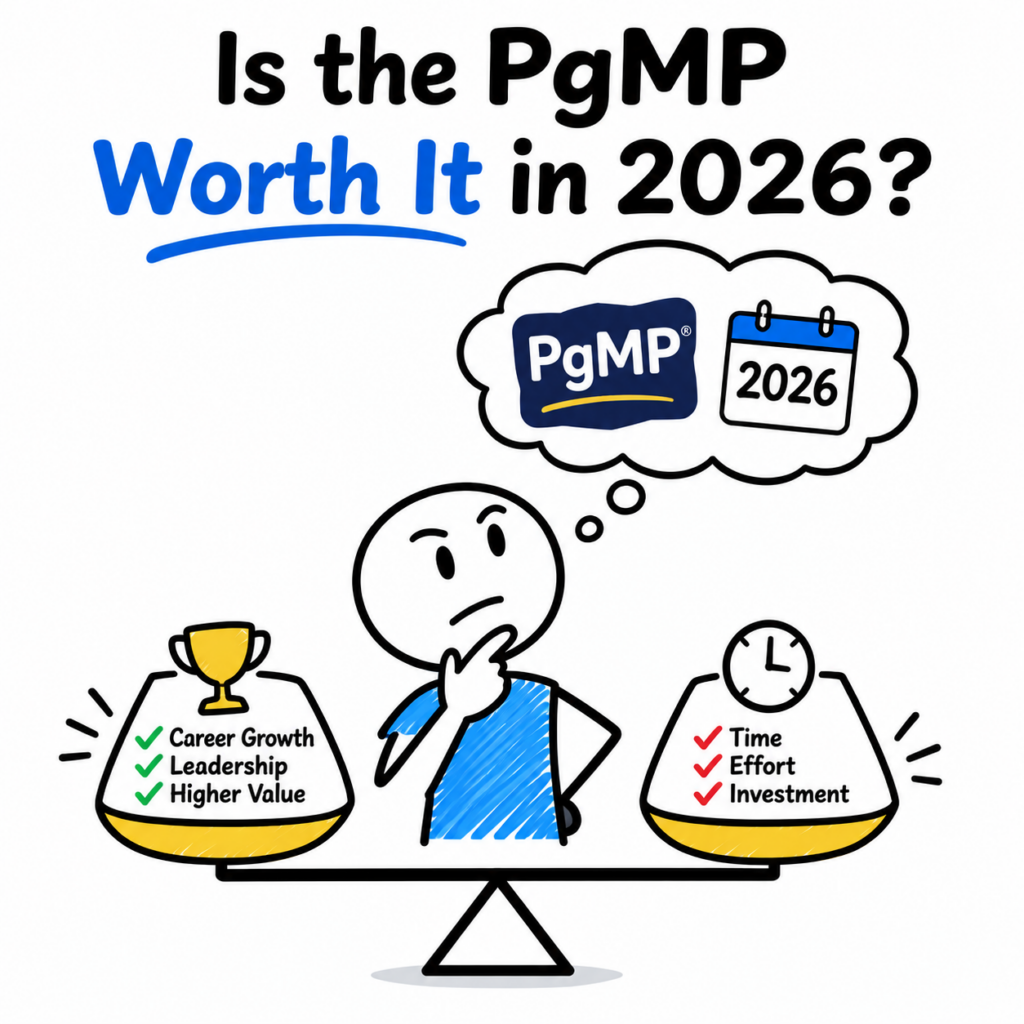
The PgMP® (Program Management Professional) asks more of you than almost any other PMI credential: years of documented program experience, a peer panel review of your application, and a four-hour exam — for a fee of around US$800. That’s a real investment of time, money and effort, so “is it worth it?” is exactly the right question to ask before you start. This guide answers it honestly: what it costs, what you get back, who it pays off for, and — just as important — who should wait.
What the PgMP actually costs you
The sticker price is only part of the picture. The real cost is money plus the time and effort to qualify and prepare.
| Cost | Roughly | Notes |
|---|---|---|
| Exam fee (PMI member) | US$800 | Non-member US$1,000 — so membership (~US$149/yr) usually nets out cheaper |
| PMI membership | ~US$149/yr | Also gets you The Standard for Program Management in the member library |
| Prep / training | Varies | Structured coaching for the application + exam; the single biggest lever on your pass rate |
| Your time | 8–12 weeks | Focused study, on top of writing a panel-ready application |
| Renewal | 60 PDUs / 3 yrs | US$60 member / US$150 non-member — the same PDUs renew your PMP too |
Notice the last row: because the PgMP renews on the same PMI CCR cycle as the PMP — 60 PDUs every three years, minimum 8 in each Talent Triangle area — the ongoing cost of holding both is the same as holding one. The same qualifying PDUs maintain both credentials at once. That materially improves the PgMP’s lifetime ROI once you already hold a PMP.
What you get back: the payoff
The return on a PgMP shows up in three places — pay, positioning, and the skills the preparation itself forces you to sharpen.
The salary premium
Program managers already sit above project managers on the pay scale, and the PgMP is a signal that you belong there. Public salary sources report the following ranges for PgMP-certified professionals in the United States (figures vary by source, region and seniority — treat them as indicative, not guaranteed):
| Role / level | Reported US range |
|---|---|
| Senior Program Manager | ~US$100,000+ |
| Director of Program Management | ~US$150,000–170,000 |
| VP, Program Management | US$200,000+ |
Positioning and scarcity
The PgMP is rare — far fewer people hold it than the PMP, precisely because the entry bar is high. That scarcity is the point. In a stack of program-manager résumés, a PgMP is a credential very few competitors can show, and it tells hiring managers and executives that PMI’s assessors have independently verified your program-level experience. For senior roles, portfolio leadership, and PMO director tracks, that differentiation is exactly what you’re paying for.
The skills you build getting there
There’s a payoff even before the certificate arrives. Preparing for the PgMP forces you to think in benefits, governance and strategic alignment rather than schedules and task lists — the exact shift that separates program managers from project managers. Candidates routinely say the discipline of writing a panel-ready application made them better at their actual job. That’s real value the credential letters don’t capture.
Is it worth it for you? A quick self-check
The PgMP is worth it if…
- You already coordinate multiple related projects toward a strategic benefit.
- You hold the PMP (or have equivalent PM experience) and can document years of program ownership.
- You’re targeting senior program, portfolio or PMO-leadership roles.
- You want a credential very few peers can show.
It’s probably not worth it yet if…
- You manage one project at a time.
- You can’t yet document 48–84 months of genuine program experience.
- You need a credential employers screen for by name — that’s still the PMP.
- You’re early in your career and building toward program roles.
If you landed on the right-hand column, the honest answer is “not yet — and that’s fine.” The highest-ROI move for you right now is to keep your PMP current with your 60 PDUs, build documented program experience, and revisit the PgMP when your day job genuinely matches it. Not sure which credential fits where you are? Read PgMP vs PMP: which certification should you get?
The biggest hidden cost — and how to control it
The verdict
The PgMP is a high-cost, high-return credential whose payoff is tightly tied to your role. For a program manager with the experience to qualify, the salary premium, the scarcity value, and the same-cycle renewal with the PMP make it one of the best-value senior credentials PMI offers. For someone not yet running programs, it’s the wrong tool at the wrong time — and the PMP, renewed with your 60 PDUs, is the smarter investment. Match the credential to the work you actually do, and the “is it worth it?” question answers itself.