PgMP, PMP, Project Management Articles
PgMP vs PMP in 2026: Which Certification Should You Get?
Aug
PgMP vs PMP in 2026: Which PMI Certification Should You Get?
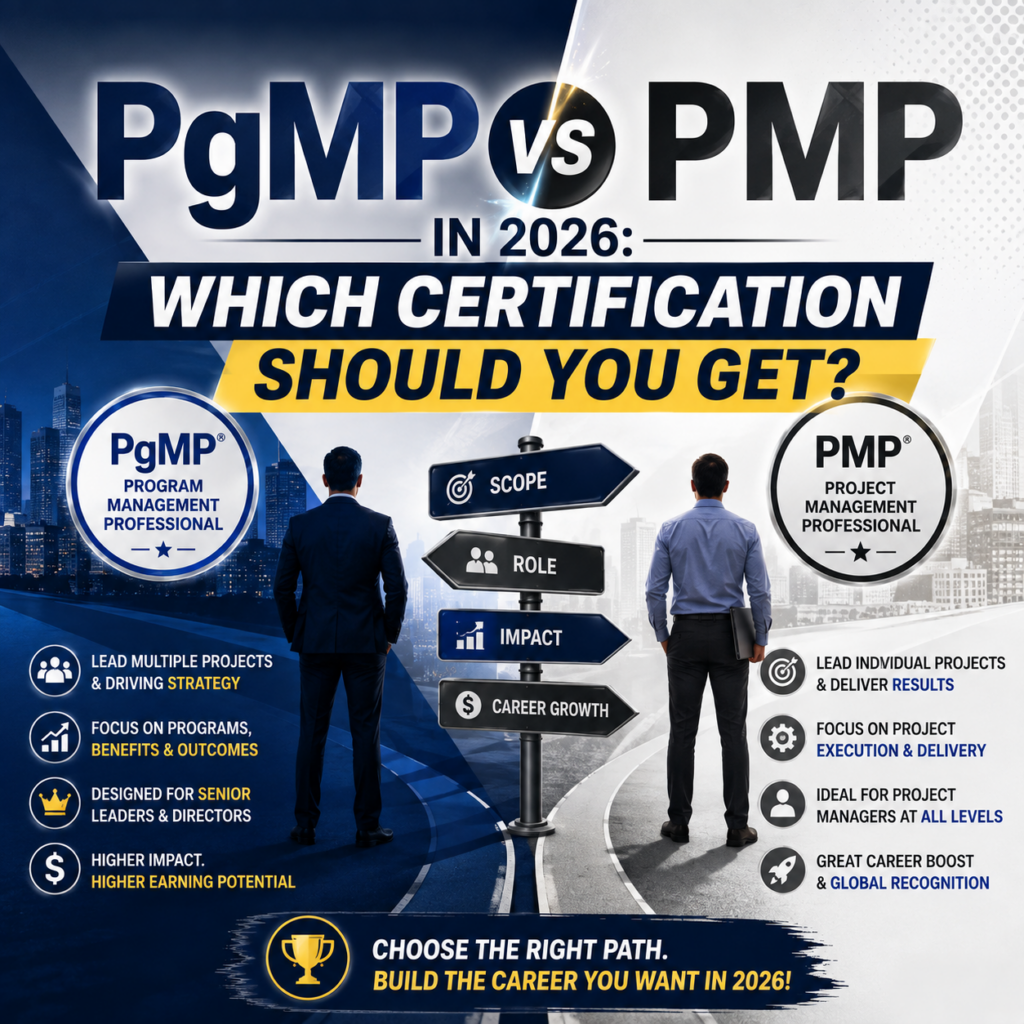
“PgMP vs PMP” is one of the most common questions PMI-certified professionals ask — but it’s slightly the wrong question. The two credentials sit at different altitudes of the same career. The PMP® (Project Management Professional) certifies that you can lead a single project. The PgMP® (Program Management Professional) certifies that you can orchestrate a program — a group of related projects managed together to deliver benefits no single project could. This guide compares them across everything that matters — eligibility, the exam, cost, difficulty, and career impact — so you can tell which one fits where you are right now.
PgMP vs PMP at a glance
| PMP | PgMP | |
|---|---|---|
| Certifies you can… | Lead a single project | Coordinate a program of related projects |
| Based on | PMBOK® Guide + PMP Exam Content Outline | The Standard for Program Management + PgMP ECO |
| Application screening | Application verified (some audited) | Application + panel review by PgMP assessors |
| Exam | 180 questions, 230 minutes | 170 questions, 240 minutes |
| Experience needed | 36–60 months project management | PM experience plus 48–84 months program management |
| Relative competition | Very widely held | Small, senior field |
| Hardest part | The exam | The application / panel review |
| Renewal | Same PMI CCR cycle — 60 PDUs every 3 years | |
The core difference: project vs program
If you’re deciding between them, this one distinction settles most of it. Running a single CRM rollout is a project — that’s PMP territory. Coordinating the CRM rollout alongside a data migration, a sales-process redesign, and a training program, all governed together to lift customer retention, is a program — that’s where the PgMP fits. The PgMP isn’t “PMP but harder”; it certifies a genuinely different kind of work.
Who should choose which
Choose the PMP if…
- You lead one project at a time.
- You want the most recognised, most requested PM credential.
- You’re earlier in your career or don’t yet have years of program ownership.
- You need a certification employers screen for by name.
Choose the PgMP if…
- You own a portfolio of related projects and their benefits.
- You already hold the PMP (or have the equivalent PM experience).
- You can document years of genuine program-level responsibility.
- You want a credential that sets you apart in a small, senior field.
Not sure you have the program experience yet? That’s the most common situation — and the honest answer is often “PMP now, PgMP later.” Keep your PMP current with your 60 PDUs, build documented program experience, and step up to the PgMP when your day job genuinely matches it.
Eligibility compared
This is the biggest practical difference. The PMP asks for project experience; the PgMP asks for project experience and a separate, larger block of program experience — then peer-reviews it.
| PMP | PgMP | |
|---|---|---|
| With a four-year degree | 36 months project management + 35 hours PM education | 48 months project management (or a PMP) + 48 months program management |
| With a secondary diploma | 60 months project management + 35 hours PM education | 48 months project management (or a PMP) + 84 months program management |
| Experience window | Within the last 8 years | Within the last 15 years |
| Extra gate | — | Panel review of your written experience summaries |
The exams compared
| PMP | PgMP | |
|---|---|---|
| Questions | 180 (mix of multiple choice, multiple response, matching, hotspot) | 170 multiple choice (150 scored + 20 pretest) |
| Time | 230 minutes, with two breaks | 240 minutes (4 hours) |
| Domains | People, Process, Business Environment | Strategic (~15%), Life Cycle (~44%), Benefits (~11%), Stakeholder (~16%), Governance (~14%) |
| What makes it hard | Volume of scenario questions across a broad body of knowledge | Answering at program level, not project level |
The counter-intuitive part: for the PgMP, the exam is often the easier gate. Once the panel approves you, the field is small and the content is tightly defined by The Standard for Program Management. The PMP exam, by contrast, is the main event — a large bank of scenario questions across a broad syllabus. So the two credentials load the difficulty in opposite places: PMP on the exam, PgMP on the application.
Cost compared (2026)
| PMP | PgMP | |
|---|---|---|
| Exam fee — PMI member | US$425 | US$800 |
| Exam fee — non-member | US$675 | US$1,000 |
| PMI membership | ~US$149/year — usually pays for itself via the lower member exam fee | |
| Renewal | US$60 members / US$150 non-members, every 3 years, plus your 60 PDUs | |
For both exams, joining PMI (~US$149/year) nets out cheaper the moment you sit the test, because the member fee is lower by more than the cost of membership — and you get the relevant standard in the member library. PMI adjusts fees periodically, so confirm the current figures on PMI.org before you budget.
Can you hold both PMP and PgMP?
Yes — and many senior practitioners do. In fact a current PMP satisfies the project-management experience requirement for the PgMP, so the PMP is a natural stepping stone. Better still, both credentials renew on the same PMI CCR cycle: 60 PDUs every three years, with a minimum of 8 PDUs in each Talent Triangle area (Ways of Working, Power Skills, Business Acumen). The same qualifying PDUs can maintain both credentials at once — so you plan your continuing education once and apply it across everything you hold.
PgMP vs PMP — FAQ
Wondering if PgMP worth the investment?